
Iridium Scrap: What It's Worth and How to Recover It
Iridium is among the rarest and most tightly supplied precious metals on earth, with global annual production running to only about 10,000 kilograms a year.
Secondary (recycled) material is a structural quarter of US precious-metal supply across gold, silver, and the platinum-group metals, not a cyclical add-on (USGS Mineral Commodity Summaries, 2024). The businesses that use it, in electrodes, thermocouples, sputtering targets, and industrial coatings, are sitting on recoverable value most never claim. This guide explains what iridium-bearing scrap looks like, why assay-based refining is the only method that pays on what is actually recovered, and how to get material to a refiner rather than discard it.
Global Iridium Production Runs to Only 10,000 Kilograms a Year
Iridium is among the scarcest of the platinum-group metals (PGMs), with annual global production amounting to only about 10,000 kilograms worldwide, a figure cited by Salzgitter AG and Umicore in their 2026 announcement of a joint anode-recycling process. For comparison, the world produced roughly 3,672 tonnes of newly mined gold in 2024 (World Gold Council, 2025). Iridium output is several hundred times smaller.
That scarcity sets the economics of the entire downstream market. When a metal is produced at that scale globally, every kilogram discarded as industrial scrap is a meaningful share of supply, and every kilogram recovered is worth the trouble of recovering it properly.
Iridium Shows Up in Five Industrial Streams Most Shops Discard
Iridium-bearing scrap is rarely obvious. It usually arrives at a refiner mixed into another material, alloyed with platinum or rhodium, coated onto a substrate, or embedded in a piece of process equipment a shop is replacing. The five streams below cover most of what businesses actually generate.
| Material | Where it comes from | Typical iridium form |
|---|---|---|
| Spark plug tips | Automotive and small-engine manufacturing scrap, end-of-life plugs | Iridium-tipped electrode, alloyed with platinum or rhodium |
| Crucibles and labware | Single-crystal growth, high-temperature chemistry, glass manufacturing | Solid iridium or platinum-iridium alloy |
| MMO and MMO-coated anodes | Electro-galvanizing, chlor-alkali, electrolyzer production | Iridium oxide coating on a titanium substrate |
| Thermocouple wire and sheaths | High-temperature furnace instrumentation | Platinum-iridium and iridium-rhodium alloy wire |
| Sputtering targets | Semiconductor, optical, and hard-disk coating | Solid iridium or iridium-alloy disk |
Each of these arrives in a different physical form, and each requires a different recovery path. The common factor is that none of them give up their iridium to a counter glance. The metal has to be sampled and assayed before anyone knows what is actually there.
MMO Anodes Carry an Iridium Coating Most Steel Mills Throw Out
Mixed-metal oxide (MMO) anodes are titanium electrodes coated with a thin layer of iridium oxide, used in continuous electro-galvanizing lines to protect steel strip as it is plated with zinc. When the coating wears down, the anode is pulled and replaced. The titanium substrate is usually recoated or scrapped, and the spent iridium-oxide residue, until recently, was largely discarded.
In January 2026, Salzgitter AG and Umicore’s Metal Deposition Solutions announced a joint process to recover iridium from spent anodes used in Salzgitter’s continuous electro-galvanizing line. Dr. Marc Debeaux of Salzgitter Mannesmann Forschung GmbH described the scale: “Here, we are talking about up to one kilogram per year.” One kilogram, against a global production base of 10,000 kilograms, is a measurable share of world supply being pulled out of a single steel plant’s residue stream.
The same logic applies to any operation running MMO anodes in chlor-alkali production, water electrolysis, hydrogen electrolyzers, or cathodic protection. The coating is thin, but the metal is there, and at iridium’s market value it is worth recovering.
Thermocouples and Crucibles Carry Iridium in Solid Alloy Form
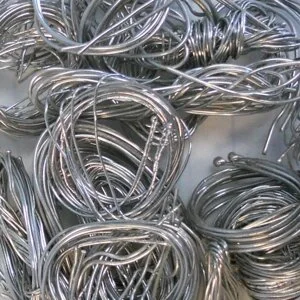
Platinum-iridium and iridium-rhodium thermocouple wire is used where standard Type R or Type S platinum-rhodium thermocouples cannot survive, in furnaces running above 2,000°C and in oxidizing atmospheres. The iridium content is not a trace coating; it is alloyed into the wire itself, typically at 10% to 40% by weight.
Iridium crucibles are used to grow single-crystal oxides for laser optics, scintillators, and specialty semiconductor substrates. A working crucible can hold several kilograms of solid iridium. When it cracks, warps, or reaches end of life, the metal is still there; it just needs to be recovered, sampled, and refined.
The same is true of iridium and platinum-iridium sputtering targets used in thin-film deposition. A used target is mostly intact iridium with surface erosion. Discarded, it is a several-thousand-dollar loss. Refined, it returns the bulk of its metal value against the market price on the settlement date.
Iridium’s 2025 Price Spike Changed the Recovery Math
Iridium is the most volatile of the platinum-group metals on price, with quoted values that have moved between roughly $4,000 and over $6,000 per troy ounce in recent years and a market thin enough that a single supply shock moves the published number sharply (Precious-metal market reporting, 2025 to 2026).
That volatility cuts in the seller’s favor when an assay-based refiner settles against the price on the day the metal is recovered. Platinum prices climbed roughly 80% in 2025 to nearly $1,600 per ounce, and palladium rose more than 80% over the same period, both outpacing gold’s gain (Precious-metal market reporting, 2025). Iridium, the rarest of the PGMs by production volume, sits at the top of that price stack. A spent anode lot, a box of cracked crucibles, or a bin of thermocouple wire that sat untouched for two years is now worth substantially more than it was when it was first set aside.
Counter Estimates Cannot Price Iridium; Only an Assay Can
Iridium does not behave like karat gold at a pawn counter. There is no visible hallmark, no acid test that tells a buyer what fraction of a piece is iridium versus platinum versus rhodium, and no reliable way to eyeball an MMO anode and quote a number. A counter estimate on iridium-bearing material is a guess, and the operator quoting it has to price for the risk of being wrong.
An assay is the only honest answer. The material is sampled, the sample is analyzed for actual metal content, and the seller is paid on what was recovered, against the London Fix or the relevant market price on the settlement date. A settlement report documents the weights and the recovered metal so the seller can see exactly what they were paid for.
For a metal that trades in the thousands of dollars per ounce and arrives in mixed alloys and thin coatings, the difference between an estimate and an assay is not a rounding error. It is the difference between a fair price and a lowball.
How Iridium-Bearing Scrap Is Sampled, Refined, and Settled
Iridium recovery follows the same arc as other PGM refining, with adjustments for the fact that iridium is chemically stubborn and harder to dissolve than platinum or palladium. The high-level path:
- Intake and weigh-in. The lot is logged by weight and material type on arrival.
- Preparation. Solid material is cut, crushed, or milled into a homogeneous form. Coated material like MMO anodes is processed to separate the iridium-bearing residue from the titanium substrate. Low-grade material like sweeps, dust, and contaminated wire is burned out to remove organics.
- Sampling. A representative sample is pulled from the prepared lot. Sampling is the most important step in the entire process; a bad sample means a bad assay no matter how good the analytical work.
- Assay. The sample is analyzed for iridium and any other precious metals present (commonly platinum, rhodium, palladium, gold, silver).
- Settlement. The seller receives a settlement report listing weights, recovered metal, and the market price applied. The seller decides whether to take payment.
- Payment. When the seller accepts, payment is issued. There is no settlement hold at Specialty Metals; once the customer says sell, the money moves.
The cycle takes days, not minutes. Iridium is harder to dissolve than its PGM cousins, which adds time, but the assay-based payout is the only number the seller can verify against a documented recovery.
How to Ship Iridium-Bearing Material to a Refiner
Iridium is dense, valuable per gram, and easy to ship. Most lots a business will generate, a few crucibles, a coil of thermocouple wire, a stack of used sputtering targets, a drum of spent anode residue, move comfortably by insured carrier.
Steps to ship:
- Describe the material. Call, text, chat, or email Specialty Metals with material type, estimated weight, and any known composition (e.g., “platinum-iridium 90/10 thermocouple wire,” “spent MMO anode residue”).
- Fill out the online form. This logs the shipment in advance so the lab knows what is arriving.
- Pack and insure. Small lots ship by USPS Registered Mail, UPS, or FedEx with insurance matching the estimated value. Large lots, drums of residue or a pallet of anodes, ship by freight; a pickup can be scheduled.
- Wait for the assay. A settlement report arrives once sampling and analysis are complete.
- Approve the settlement. Payment is issued the same day the seller accepts.
The economics make the freight a rounding error. A single iridium crucible can carry more recoverable metal value than the entire cost of insured ground shipping across the country.
Where Specialty Metals Sits Against Other Iridium Recovery Routes
Iridium-bearing scrap usually faces one of four destinations. Each comes with a different trade-off on documentation, scope, and who actually gets paid.
| Route | How it pays | Iridium handling | Best for |
|---|---|---|---|
| Specialty Metals | Assay-based settlement, no settlement hold, settlement report documents recovered metal | Refines iridium-bearing scrap across crucibles, wire, targets, anodes, sweeps | Jewelers, dental labs, industrial accounts, and individuals with iridium-bearing material |
| Cash-for-gold storefront | Counter estimate on visible gold and silver | Will not price iridium; usually refuses the material | Marked karat gold or silver only, never PGM scrap |
| Sabin Metal Corporation | Industrial contract settlement on spent catalysts | Industrial-scale PGM recovery from process catalysts | Refineries and chemical plants with very large catalyst lots |
| Garfield Refining | Assay-based settlement on dental and jewelry scrap | Primarily gold, silver, platinum, palladium from dental and jewelry | Dental labs and jewelers with karat and dental alloy scrap |
The honest read on this matrix: a storefront cannot price iridium, an industrial refiner like Sabin is built for contract-scale catalyst lots and not for a single crucible or a coil of thermocouple wire. Specialty Metals is positioned for the seller who has iridium-bearing scrap, often mixed with other PGMs, and wants an assay-based settlement without a multi-month industrial contract.
Frequently Asked Questions
Why is iridium so much rarer than platinum or palladium?
Iridium is one of the least abundant elements in the Earth’s crust and is recovered almost entirely as a by-product of platinum and nickel mining. Total global production is roughly 10,000 kilograms a year, against hundreds of tonnes for platinum and palladium combined.
What is iridium used for, beyond electrodes?
Iridium goes into spark plug tips, high-temperature crucibles for crystal growth, thermocouple wire, sputtering targets, MMO anodes for electro-galvanizing and chlor-alkali, and increasingly into electrodes for hydrogen electrolyzers. Demand from electrolyzer manufacturing is the reason iridium’s strategic importance keeps rising.
Can iridium be alloyed with other metals in scrap?
Yes, almost always. Iridium is most commonly seen in scrap as a platinum-iridium alloy (thermocouple wire, crucibles), an iridium-rhodium alloy (thermocouples), or an iridium-oxide coating on titanium (MMO anodes). An assay reports each metal separately, and the seller is paid on each.
Is there a minimum quantity to refine iridium-bearing material?
Specialty Metals does not turn away small lots of iridium-bearing scrap, because the metal is dense and valuable per gram. A single used crucible or a few hundred grams of thermocouple wire is worth processing. Call ahead with the material description; the team will confirm before the shipment moves.
How long does an iridium assay take?
Iridium is harder to dissolve than platinum or palladium, so the chemistry runs longer than a straight gold or silver assay. The full cycle, intake through settlement report, is days rather than minutes; the exact window depends on lot size and material complexity.
What price is the settlement based on?
The settlement is calculated against the prevailing market price for each recovered metal on the settlement date.
The LBMA Gold Price benchmark is set twice daily, at 10:30 and 15:00 London time, in US dollars per fine troy ounce of 995 gold, through an independently administered electronic auction run by ICE Benchmark Administration and regulated by the UK Financial Conduct Authority (LBMA / ICE Benchmark Administration, 2025). Iridium does not have a London Fix the way gold and silver do, but its quoted market price is published by the major refiners and trading houses, and that is the reference applied.
Will the refiner buy MMO anodes that look completely worn out?
Yes. The iridium-oxide coating on a spent anode is exactly what is being recovered. A worn anode is not a worthless anode; it is the source material. Salzgitter’s joint process with Umicore recovers up to a kilogram of iridium per year from exactly this kind of residue.
What about iridium-bearing material that has been in storage for years?
Iridium does not degrade.
Recovering metal from scrap rather than ore can cut associated air pollution by roughly 80% and water pollution by roughly 76%, while reducing water consumption by roughly 40% compared with primary mining (Metal-recycling environmental analysis, 2024). A crucible, a coil of wire, or a barrel of residue that has sat on a shelf for a decade still carries the same metal it carried when it was set aside. The market price has almost certainly moved, usually upward, in the intervening years.
How Specialty Metals Refines Iridium-Bearing Scrap on an Assay Basis
Specialty Metals refines iridium alongside the rest of the platinum-group metals on an assay basis, sampling each lot, analyzing it for actual metal content, and settling against the market price on the date the metal is recovered. The settlement report documents the weights and recovered metal so the seller can see what they were paid for, line by line.
The shop accepts iridium-bearing material across the full range of industrial forms: platinum-iridium and iridium-rhodium thermocouple wire, used crucibles, spent sputtering targets, MMO anode residues, sweeps, and mixed PGM scrap. Small lots ship by insured carrier; large lots move by freight with a scheduled pickup. There is no settlement hold; once the seller accepts the settlement, payment is issued.
For a metal that is produced at a global rate of only 10,000 kilograms a year and trades in the thousands of dollars per ounce, the gap between a counter estimate and a documented assay is not a theoretical concern. It is the difference between getting paid on what was recovered and getting paid on what someone guessed.
Specialty Metals is the assay-based refiner for businesses sitting on iridium-bearing scrap most processors will not price. Call 800-426-2344 or describe the material through the online form for a no-obligation quote.
Related Posts
Everything You Need to Know about Making Money by Recycling Iridium
What Are The Best Places to Look for Platinum and Platinum Alloy Scrap?
What Platinum Family Metals Make the Best Investments?
How to Pick the Best Precious Metals Recycling Company
What You Need to Know about Environmentally Friendly Platinum Refining